
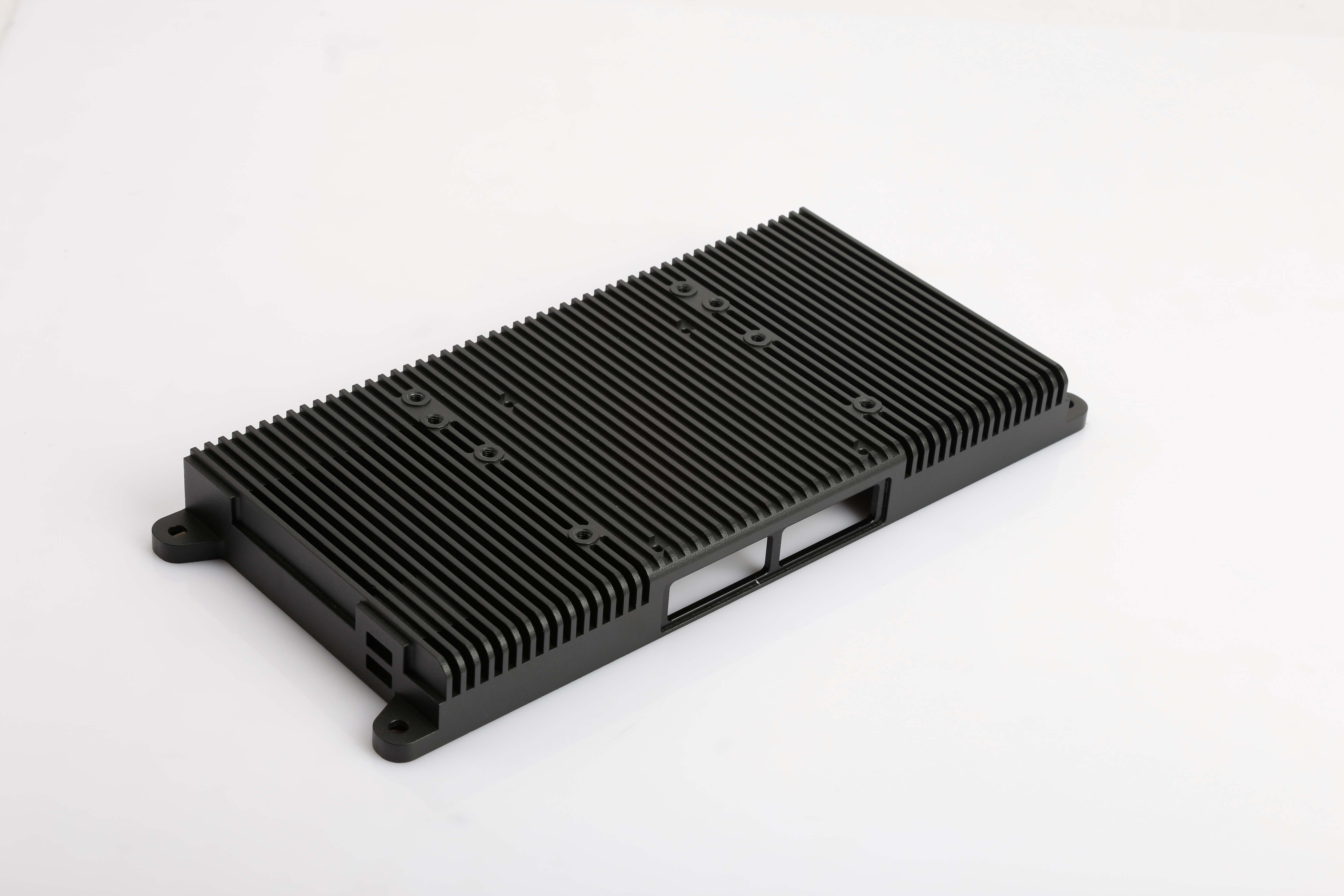
Les dissipateurs thermiques extrudés sont des composants essentiels des systèmes de gestion thermique modernes. Conçus pour dissiper efficacement la chaleur des dispositifs électroniques, LED et automobiles, ils sont fabriqués par extrusion d'aluminium ou de cuivre. Ces pièces offrent une excellente conductivité thermique, une grande résistance mécanique et une grande flexibilité de personnalisation. Le procédé d'extrusion permet des géométries d'ailettes complexes et des flux d'air optimisés, aboutissant à des composants de dissipation thermique légers et performants, adaptés à une large gamme d'applications exigeantes.
extrusion heat sink parts refer to précision-engineered thermal components produced through metal extrusion technology, primarily using aluminum alloys (6063, 6061) or copper.
the extrusion process shapes heated metal through a die to form profiles with complex fins, grooves, and channels. this technique creates large-surface-area structures that maximize air contact and cooling efficiency while maintaining excellent material integrity.
because aluminum heat sink extrusions combine lightweight design, good machinability, and cost-effectiveness, they are widely used in électronique grand public, éclairage LED, power modules, automotive systems, and industrial controllers.
for more demanding thermal environments, copper aluminum heat sinks are preferred due to their superior thermal conductivity and stability under high loads.
Les pièces du dissipateur thermique par extrusion sont fabriquées à partir de matériaux à haute conductivité tels que les alliages d'aluminium et le cuivre.
Les dissipateurs thermiques en aluminium offrent un équilibre idéal entre conductivité et poids.
copper extrusions are used in high-power or compact systems that require superior heat transfer.
these materials ensure efficient heat transfer from the source to the fins, allowing faster thermal dissipation and stable device performance.
the extruded heat sink fins or extended surfaces significantly increase the total heat exchange area.
this design promotes rapid heat transfer between the sink and ambient air, achieving enhanced cooling efficiency without increasing the overall volume.
thanks to the use of lightweight aluminum materials, extrusion heat sink parts are suitable for weight-sensitive applications such as aerospace, électronique automobile, and portable consumer devices.
despite being lightweight, these parts exhibit high mechanical strength and excellent resistance to vibration, thermal cycling, and mechanical stress.
the heat sink extrusion process enables custom designs tailored to specific applications.
manufacturers can precisely define profile size, fin shape, base thickness, and mounting holes to meet customer requirements.
this flexibility makes custom extruded aluminum heat sinks ideal for oem and odm projects.
extruded heat sinks have dense and uniform microstructures that resist deformation and fatigue.
they can maintain consistent performance even under high-pressure or high-temperature conditions, ensuring the long-term stability of high-power electronics.
cnc machined extrusion heat sink parts are manufactured to tight tolerances to ensure perfect contact between the heat sink and heat-generating components.
précision control minimizes interface resistance and maximizes thermal transfer.
such high-accuracy standards are essential in hpc servers, led drivers, power modules, and cpu cooling systems.
Pour améliorer les performances et l'esthétique, diverses techniques de finition de surface sont appliquées :
L'anodisation crée une couche d'oxyde résistante à la corrosion sur les surfaces en aluminium, améliorant ainsi l'apparence et les performances thermiques.
Revêtement par pulvérisation – offre une protection supplémentaire et des options de couleur, adapté aux environnements difficiles ou extérieurs.
Le placage électrolytique (nickel/chrome) améliore la résistance à la corrosion et à l'usure, couramment utilisé dans les dissipateurs thermiques en cuivre.
Revêtement en oxyde noir – améliore l'efficacité de la dissipation de la chaleur par rayonnement dans les environnements à haute température.
Revêtement thermique – les revêtements avancés améliorent encore l'émissivité et la protection de l'environnement.
in smartphones, laptops, desktops, and tvs, extrusion heat sink parts play a key role in maintaining optimal device temperatures.
their compact yet efficient design allows lightweight cooling solutions in space-constrained environments.
led heat sink extrusions are critical for thermal management in led lamps, downlights, and streetlights.
the large fin surface quickly transfers heat from led chips to the air, ensuring stable light output, energy efficiency, and extended lifespan.
in electric vehicles (evs) and adas systems, extruded aluminum heat sinks are used in battery management systems, motor controllers, and on-board computers.
their robust mechanical strength and lightweight nature meet strict automotive design and safety standards.
industrial control panels, inverters, power amplifiers, and communication base stations rely on high-power heat sink extrusions for continuous thermal regulation.
bonded fin heat sinks or skived fin heat sinks are often used in applications that demand maximum heat transfer efficiency.
as a leading aluminum heat sink manufacturer and supplier, we specialize in custom heat sink extrusion, cnc machining, and surface finishing for global clients.
our engineering team offers oem/odm customization, bulk production, and thermal design optimization for led, power, automotive, and industrial applications.
we ensure each extruded heat sink profile meets international standards for précision, performance, and durability.
q1: what are the main advantages of extrusion heat sink parts?
a1: they provide excellente conductivité thermique, customizable geometry, low cost, lightweight design, and high mechanical strength. the extrusion process enables mass production with precise dimensional control.
q2: what materials are commonly used?
a2: the most common are 6063-t5 aluminum and 6061-t6 aluminum alloys, offering good conductivity and formability. for higher performance, copper extrusion heat sinks are also available.
q3: do they require surface treatment?
a3: yes. treatments such as anodizing, electroplating, or black coating enhance corrosion resistance, durability, and thermal emissivity.
q4: are extruded heat sink parts suitable for high-power applications?
a4: absolutely. they are widely used in ev systems, data centers, and éclairage LED, where efficient heat dissipation is critical.
q5: how can heat dissipation efficiency be improved?
a5: use denser fin arrangements, optimized airflow paths, materials with higher thermal conductivity, and surface coatings that increase heat radiation efficiency

Kingka Tech Industriel Limitée
Nous sommes spécialisés dans les dissipateurs thermiques, les plaques froides liquides et l'usinage CNC de précision. Nos produits sont largement utilisés dans les secteurs des télécommunications, de l'aérospatiale, de l'automobile, du contrôle industriel, de l'électronique de puissance, des instruments médicaux, de l'électronique de sécurité, de l'éclairage LED et du multimédia.


adresse:
village nouveau de Da Long, ville de Xie Gang, ville de Dongguan, province du Guangdong, Chine 523598
e-mail:
tél. :
+86 137 1244 4018